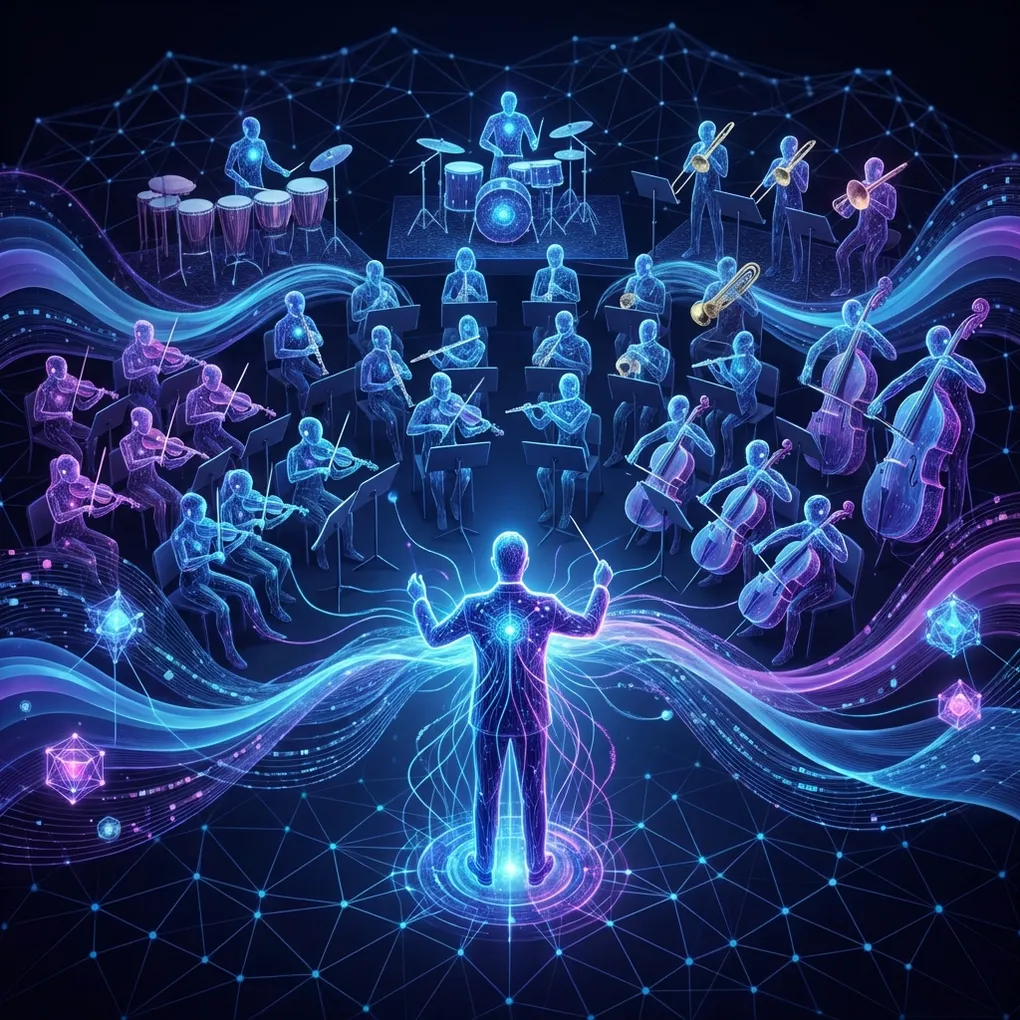
The Orchestra: Why Multi-Agent AI Works
One model can’t do everything. At enterprise scale, the “one-man band” isn’t just inefficient—it’s a reliability risk.
📑 In This Article:
- The Problem
- The Insight
- How It Works
- When to Use It
- Real-World Examples Across Industries
- 📦 Case Study: Vibe Product Design
- The Pattern That Repeats
- Key Takeaways
- References
The Problem
The “Superman” approach—where one person handles everything from engineering to marketing to operations—creates a fatal bottleneck. This is identical to a football team over-relying on Messi or Ronaldo to win the Champions League.
The mechanism is clear: Individual brilliance scales to a point. Then it breaks.
You ask an AI to help with a complex, multi-step workflow.
It starts well—gathers information, makes decisions, drafts initial outputs.
Then it forgets what it said earlier. Contradicts itself. Loses the thread.
We’ve all been there. But at enterprise scale, this isn’t just annoying—it’s a reliability crisis.
This is the Monolithic Model Paradox: The more complex your task, the exponentially more likely a single model is to fail.
| The Enterprise Risk | What Happens |
|---|---|
| 📉 The “Context Rot” | Even with 1M tokens, reasoning quality degrades in the “middle” of long contexts. |
| 🎲 Non-Determinism | A single model tackling 10 steps compounds a 5% error rate into a 40% failure rate. |
| 🛡️ Auditability Gap | When one “black box” does everything, you can’t trace why a decision was made. |
| ⚠️ Instruction Fog | Too many tools/rules in one prompt confuses the model, leading to tool misuse. |
📊 The Reality Check:
What the Industry Shows Why It Matters Source 62% of organizations are experimenting with AI agents, but only 23% are scaling — McKinsey, 2025 The wide gap between experimentation and production suggests that scaling requires architectural thinking — not just a better model. McKinsey State of AI Gartner: 40% of enterprise apps will integrate task-specific agents by end of 2026 — Gartner, 2025 An 8× increase in one year signals that multi-agent is moving from research into mainstream enterprise adoption. 🔒 Gartner Research · Subscription required GraphRAG shows 87% vs 23% accuracy over classical RAG for multi-hop reasoning — Enterprise Benchmarks, 2025 When tasks require connecting information across sources, specialized agents working together significantly outperform a single generalist. 🔒 Enterprise RAG Benchmarks · Analyst report
The Insight
Multi-agent AI systems work like championship-winning football teams.
Vicente del Bosque once said about Sergio Busquets:
“If you watch the game, you don’t see Busquets. But if you watch Busquets, you see the whole game.”
This is the secret of legendary midfielders—Paul Scholes, Michael Carrick, Toni Kroos. They never appear in the highlights. No spectacular goals. No flashy dribbles. Yet they control the entire match. They read the game, distribute the ball, and create the structure that lets attackers shine.
In multi-agent systems, the Orchestrator is your Busquets.
It doesn’t generate the flashy output. It doesn’t retrieve the documents or call the APIs. But it sees the whole workflow. It routes tasks to specialists, synthesizes their outputs, and ensures quality before anything reaches the user.
💡 The Key Principle: Specialization isn’t just about performance—it’s the only way to achieve reliability at scale.
According to Anthropic’s internal research, a multi-agent architecture (orchestrator + subagents) achieved a 90.2% increase in accuracy on complex software tasks.
This aligns with Google’s “Level 3” Agent Taxonomy: moving from simple response generation to Collaborative Multi-Agent Systems that can handle dynamic, non-linear workflows.
This isn’t just a software pattern — it’s a law of nature. Watch how an ant colony operates. No single ant knows the blueprint. No ant has a “master plan.” Yet collectively, they build ventilated structures, optimize foraging routes, and adapt to threats — all through specialization and chemical signaling. The queen doesn’t micromanage. Scout ants scout. Soldier ants defend. Worker ants build. Each one excels at a narrow task, and the emergent intelligence of the colony far exceeds any individual ant’s capability.
Multi-agent systems work the same way. The orchestrator sends signals (not pheromones, but routing decisions). Specialist agents respond within their domain. And the system’s intelligence emerges from coordination, not from any single model being “smart enough.”
That’s the difference between a prototype and production. Between freestyle street football chasing the ball—and a squad with structure, roles, and a midfield general orchestrating every move.
How It Works
Every enterprise-grade system needs structure. Multi-agent systems enforce it through three pillars.
The Three Pillars
| Pillar | What It Is | Enterprise Value | Example |
|---|---|---|---|
| 🧠 Model | The reasoning brain | Smart Routing: Balances Cost/Latency vs. Accuracy. Small, fast models (e.g., Llama 3 8B) handle simple orchestration. Heavy models (e.g., GPT-4o) handle complex reasoning. | Using a fast 8B model to classify an email’s intent, then routing to an expensive heavy model only if a complex technical reply is needed. |
| 🤲 Tools | The ability to act | Context Protection & Security: Offloads processing via MCP/skills to prevent context window overflow, reducing costs. Enforces Principle of Least Privilege. | Instead of pasting a 10,000-row CSV into the prompt, giving the agent a query_database tool to fetch exactly the 5 relevant rows. |
| 🎯 Orchestration | The coordination layer | Decoupled Governance: Separates reasoning from state management. Provides a central state machine to log, audit, and trace every execution path. | A Chief Architect agent that reviews a Coder agent’s output and can automatically trigger a “revision loop” if quality checks fail. |
The Conductor (Orchestrator) is your governance layer. It ensures:
- Routing: The right task goes to the right specialist agent.
- Synthesis: Disparate outputs are merged into a coherent result.
- Quality Control: Bad outputs are rejected before they reach the user.
The Agentic Loop
Each specialist follows a strict Reasoning Cycle (Perceive → Reason → Act → Learn).
Why does this matter for valid enterprise use? Observability. Because each agent is a distinct entity, you can see exactly where the process failed. Did the Researcher miss a fact? Did the Writer hallucinate? You can fix the specific component without retraining the entire system.
When to Use It
Multi-agent systems add complexity. Use them only when the Cost of Failure exceeds the Cost of Complexity.
| Scenario | Recommendation | Why |
|---|---|---|
| Simple Q&A | Single Agent | Overhead. An orchestra for one lookup is overkill. |
| Document Summary | Single Agent | Linear transformation. No conflicting requirements. |
| Complex Research | Multi-Agent | A Searcher + Verifier prevents hallucinations. |
| End-to-End Workflows | Multi-Agent | Conflicting constraints (creativity vs. compliance) need separation. |
| Production Systems | Multi-Agent | A “Critic” agent acts as a quality gate. Rejects bad output automatically. |
Real-World Examples Across Industries
The same multi-agent pattern applies everywhere. Here’s how it looks in three different domains:
🏦 Banking: Loan Origination
A customer applies for a mortgage. Single model? It forgets the debt-to-income ratio by step 6 and misapplies regulations.
Multi-Agent Solution:
| Agent | Role | Tools |
|---|---|---|
| Document Agent | Verify income, tax returns | OCR, employer API |
| Credit Agent | Pull credit reports, calculate DTI | Experian, Equifax APIs |
| Compliance Agent | Enforce TILA, RESPA rules | Regulation database |
| Orchestrator | Route tasks, synthesize decision | Audit logger |
Result: Each agent logs its reasoning. Regulators can trace exactly why a loan was approved or denied.
🛒 Retail: Returns & Fraud Detection
A customer requests a refund for an expensive item. Is it legitimate return or fraud?
Multi-Agent Solution:
| Agent | Role | Tools |
|---|---|---|
| Pattern Agent | Detect anomalies in return history | Transaction database |
| Investigation Agent | Gather context: purchase history, device, location | CRM, fraud signals |
| Policy Agent | Apply return rules, calculate refund | Policy engine |
| Orchestrator | Route, escalate to human if confidence < 90% | Approval workflow |
Result: Legitimate returns processed instantly. Fraudulent patterns flagged for review.
🎓 Education: Personalized Learning Path
A student needs a customized curriculum based on their skill gaps. One model? It either oversimplifies or overwhelms.
Multi-Agent Solution:
| Agent | Role | Tools |
|---|---|---|
| Assessment Agent | Evaluate current skill level | Quiz engine, diagnostic tests |
| Curriculum Agent | Design learning path based on gaps | Course catalog, prerequisites DB |
| Content Agent | Select/generate appropriate materials | LMS, video library |
| Mentor Agent | Provide encouragement, track progress | Notification system |
Result: Each student gets a tailored path. The Assessment Agent identifies gaps; the Curriculum Agent builds the plan; the Content Agent delivers materials at the right level.
📦 Case Study: Vibe Product Design
We didn’t just write about this—we built it. Vibe Product Design is an agentic system that turns a simple idea into a full technical architecture (BRD, FRD, Database Schema, API Spec) in minutes.
It uses a Supervisor Pattern where a ChiefArchitect (the orchestrator) coordinates three specialists.
The Team Structure
| Agent | Role | The “Superpower” |
|---|---|---|
| Chief Architect | Orchestrator | Maintains the state machine, routes tasks, and enforces quality gates. |
| Product Manager | Specialist | Focuses purely on user value and business viability (Lean Canvas). |
| Business Analyst | Specialist | Translates vision into requirements (BRD/FRD) with acceptance criteria. |
| Solution Architect | Specialist | Designing the technical system (C4 Diagrams, ERD, API Specs). |
The Routing Logic
Here is the actual code from workflow.py that decides who works next. Notice how the Orchestrator (route_next_step) is the only one allowed to move the process forward or backward based on quality checks.
# From studio/vibe-product-design/backend/app/core/workflow.py
def route_next_step(state: ProjectState) -> str:
    """
    Chief Architect decides the next step based on current phase and quality status.
    """
    current_phase = state["phase"]
    quality_score = state.get("last_quality_score", 0.0)

    # QUALITY GATE: If score is too low, send back for revision
    if quality_score < 4.0 and state["revision_count"] < 3:
        return "revision_node"

    # ROUTING LOGIC: Map phase to specialist
    if current_phase == "strategy":
        return "product_manager_node"  # PM builds Lean Canvas
    elif current_phase == "requirements":
        return "business_analyst_node" # BA builds BRD
    elif current_phase == "architecture":
        return "solution_architect_node" # SA builds C4/ERD

    return "end"
The Lesson: By explicitly defining these routes, we prevent the “Product Manager” from trying to write SQL code. Each agent stays in their lane, and the Chief Architect ensures the baton pass happens correctly.
The Pattern That Repeats
Notice the common structure across all three industries:
| Stage | Banking | Retail | Education |
|---|---|---|---|
| Input | Document verification | Return request | Skill assessment |
| Analysis | Credit analysis | Pattern detection | Gap analysis |
| Decision | Compliance check | Policy application | Curriculum design |
| Output | Loan decision | Refund decision | Learning path |
The Enterprise Litmus Test: If you can define a Standard Operating Procedure (SOP) for a human team to do the task, you can encode that SOP into a multi-agent workflow. Agents scale process, they don’t invent it.
🔍 The Multi-Agent Overreach
You split your monolith agent into 5 specialists. Latency tripled. Cost quadrupled. Quality stayed the same.
Three traps teams fall into when adopting multi-agent:
| The Trap | What Teams Do | What Goes Wrong | The Fix |
|---|---|---|---|
| 🎭 “More agents = better” | Split every task into specialist agents because “separation of concerns” | Each agent handoff adds latency (LLM call + context serialization). A 5-agent pipeline that could be a single well-prompted agent now costs 5× the tokens and takes 5× longer. Specialization only helps when agents need different knowledge, not just different tasks. | Apply the complexity threshold: use multi-agent only when a single agent can’t hold all required context in its window, or when tasks require fundamentally different tool sets. If one prompt + one tool set covers it, one agent is better. |
| 🔄 “Agents will coordinate themselves” | Build agents and assume they’ll figure out the handoffs | Without explicit state passing, Agent B doesn’t know what Agent A decided or why. Each agent re-derives context from scratch. Information is lost at every handoff. The orchestra has musicians but no sheet music. | Define an explicit shared state schema that flows between agents. Every handoff must include: what was decided, why, and what’s needed next. The state is the sheet music — without it, agents improvise (badly). |
| 📊 “Hard to debug, but that’s the tradeoff” | Accept that multi-agent systems are inherently opaque | When the final output is wrong, you can’t tell which agent failed or where the reasoning broke down. Was it the research agent retrieving bad data? The analysis agent misinterpreting it? Or the writer agent ignoring the analysis? Debugging becomes archaeology. | Implement per-agent trace logging from day one. Each agent logs its input, reasoning, output, and confidence. When the chain fails, you can isolate the broken link in minutes, not hours. |
💡 The Meta-Principle: Multi-agent is a scaling solution, not a quality solution. A single agent that’s well-prompted and well-tooled will outperform a poorly coordinated team of specialists. Only split when the single-agent approach hits a concrete wall — context overflow, tool conflicts, or genuine domain boundaries.
Key Takeaways
- ✅ Reliability requires redundancy: A single model is a single point of failure. Agents working in loops provide self-healing.
- ✅ Context needs boundaries: “Context Rot” is real. Agents keep context short, focused, and effective.
- ✅ Governance needs architectural support: Orchestrators provide the audit trail compliance teams demand.
- ✅ Scale capabilities, not prompts: Don’t build a bigger prompt; build a better team of agents.
- ✅ The pattern is universal: Banking, Retail, Education—the same architecture adapts to any domain.
What’s Next
- 📖 Next article: The 4 Pillars: Persona, Skills, RAG, MCP — A decision framework for agent context.
- 💬 Discuss: How are you handling reliability in your agent workflows?
References
-
Anthropic — Building Effective Agents (2024). Highlights 90.2% accuracy in multi-agent architectures vs single-agent baselines for complex tasks. anthropic.com/research/building-effective-agents
-
LangGraph — Multi-Agent Supervisor Pattern. The standard reference architecture for centralized orchestration and state management. langchain-ai.github.io/langgraph
-
Google Cloud — Vertex AI Agents. Defines the “Perceive-Reason-Act” loop as the core of agentic reasoning. cloud.google.com/vertex-ai/docs/agent-engine
-
Galileo — The “Lost in the Middle” Phenomenon. Research on how LLM reasoning quality degrades as context window usage increases.
-
Google Cloud Research — Introduction to Agents (2025). Defines the 5-level taxonomy of agentic systems, positioning multi-agent teams as “Level 3” collaborative systems.
❓ Frequently Asked Questions
Why use multi-agent AI instead of a single model?
Specialized agents with clear roles achieve up to 90.2% higher accuracy on complex tasks (per Anthropic research) because they avoid context rot, enable focused expertise, and provide auditability.
What are the three pillars of multi-agent systems?
Model (the reasoning brain), Tools (the ability to act), and Orchestration (the conductor that coordinates everything).
When should I use multi-agent vs single-agent systems?
Use single-agent for simple Q&A or document summaries. Use multi-agent when you need complex research, end-to-end design, or production workflows with quality gates.
💬 Join the Discussion
Got questions, feedback, or want to share your experience building AI agents? Join our community of architects and engineers.