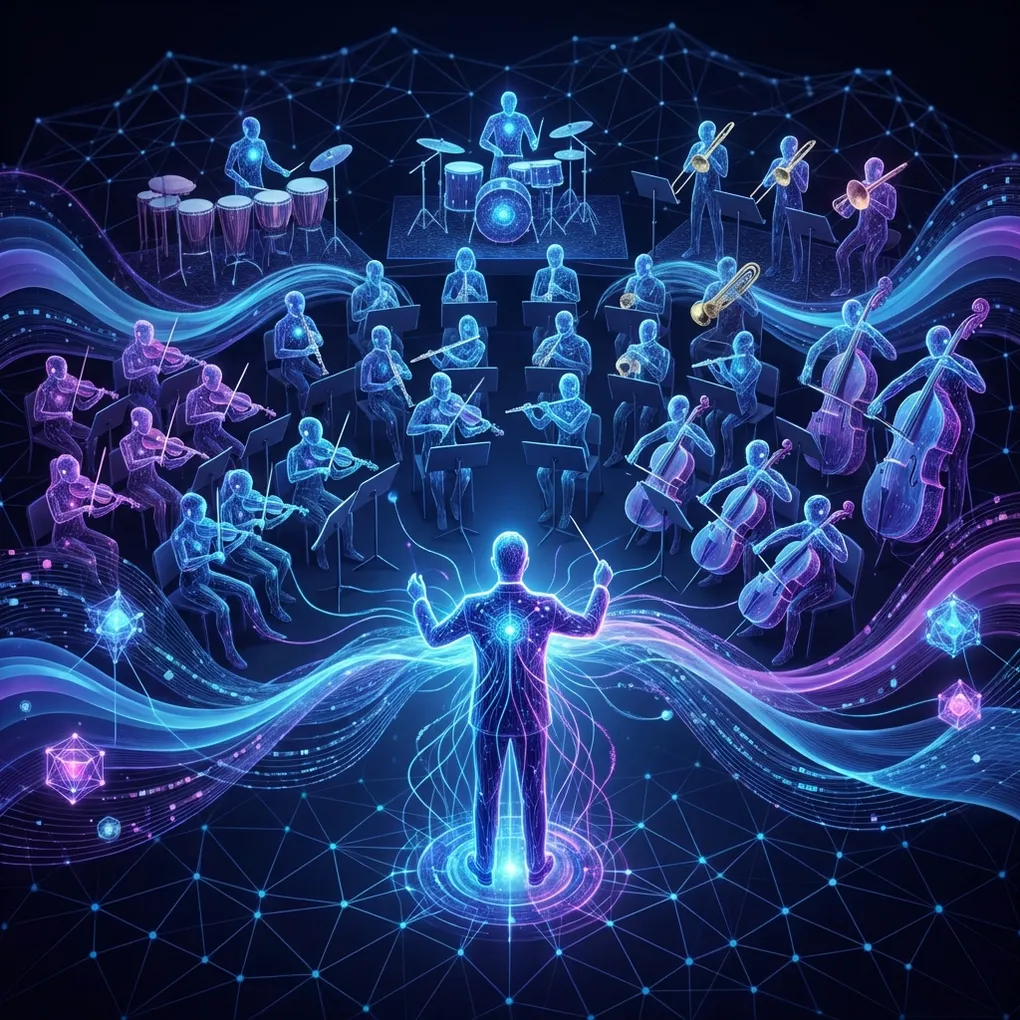
The Orchestra: Why Multi-Agent AI Works
One model can’t do everything. At enterprise scale, the “one-man band” isn’t just inefficient—it’s a reliability risk.
The Problem
You ask an AI to help with a complex, multi-step workflow.
It starts well—gathers information, makes decisions, even drafts initial outputs.
Then it forgets what it said earlier. Contradicts itself. Loses the thread.
We’ve all been there. But in an enterprise context, this isn’t just annoying—it’s critical.
This is the Monolithic Model Paradox: The more complex your task, the exponentially more likely a single model is to fail.
| The Enterprise Risk | What Happens |
|---|---|
| 📉 The “Context Rot” | Even with 1M tokens, reasoning quality degrades in the “middle” of long contexts. |
| 🎲 Non-Determinism | A single model tackling 10 steps compounds a 5% error rate into a 40% failure rate. |
| 🛡️ Auditability Gap | When one “black box” does everything, you can’t trace why a decision was made. |
| ⚠️ Instruction Fog | Too many tools/rules in one prompt confuses the model, leading to tool misuse. |
The Insight
Multi-agent AI systems work like orchestras.
Instead of one performer trying to do everything, you have specialized musicians—each excellent at their instrument—working in harmony under a conductor.
💡 The Key Principle: Specialization isn’t just about performance—it’s the only way to achieve reliability at scale.
According to Anthropic’s internal research, a multi-agent architecture (orchestrator + subagents) achieved a 90.2% increase in accuracy on complex software tasks.
This aligns with Google’s “Level 3” Agent Taxonomy: moving from simple response generation to Collaborative Multi-Agent Systems that can handle dynamic, non-linear workflows.
That’s the difference between a prototype and production.
How It Works
Every enterprise-grade system needs structure. Multi-agent systems enforce it through three pillars.
The Three Pillars
| Pillar | What It Is | Enterprise Value |
|---|---|---|
| 🧠 Model | The reasoning brain | Focus: Smaller, specialized models outperform one giant model given too many tasks. |
| 🤲 Tools | The ability to act | Security: Agents only get the tools they need, enforcing Principle of Least Privilege. |
| 🎯 Orchestration | The coordination layer | Governance: A central point to log, audit, and approve every decision. |
The Conductor (Orchestrator) is your governance layer. It ensures:
- Routing: The right task goes to the right specialist agent.
- Synthesis: Disparate outputs are merged into a coherent result.
- Quality Control: Bad outputs are rejected before they reach the user.
The Agentic Loop
Each specialist follows a strict Reasoning Cycle (Perceive → Reason → Act → Learn).
Why does this matter for valid enterprise use? Observability. Because each agent is a distinct entity, you can see exactly where the process failed. Did the Researcher miss a fact? Did the Writer hallucinate? You can fix the specific component without retraining the entire system.
When to Use It
Multi-agent systems add complexity. Use them only when the Cost of Failure exceeds the Cost of Complexity.
| Scenario | Recommendation | Why |
|---|---|---|
| Simple Q&A | Single Agent | Overhead. An orchestra for one lookup is overkill. |
| Document Summary | Single Agent | Linear transformation. No conflicting requirements. |
| Complex Research | Multi-Agent | A Searcher + Verifier prevents hallucinations. |
| End-to-End Workflows | Multi-Agent | Conflicting constraints (creativity vs. compliance) need separation. |
| Production Systems | Multi-Agent | A “Critic” agent acts as a quality gate. Rejects bad output automatically. |
Real-World Examples Across Industries
The same multi-agent pattern applies everywhere. Here’s how it looks in three different domains:
🏦 Banking: Loan Origination
A customer applies for a mortgage. Single model? It forgets the debt-to-income ratio by step 6 and misapplies regulations.
Multi-Agent Solution:
| Agent | Role | Tools |
|---|---|---|
| Document Agent | Verify income, tax returns | OCR, employer API |
| Credit Agent | Pull credit reports, calculate DTI | Experian, Equifax APIs |
| Compliance Agent | Enforce TILA, RESPA rules | Regulation database |
| Orchestrator | Route tasks, synthesize decision | Audit logger |
Result: Each agent logs its reasoning. Regulators can trace exactly why a loan was approved or denied.
🛒 Retail: Returns & Fraud Detection
A customer requests a refund for an expensive item. Is it legitimate return or fraud?
Multi-Agent Solution:
| Agent | Role | Tools |
|---|---|---|
| Pattern Agent | Detect anomalies in return history | Transaction database |
| Investigation Agent | Gather context: purchase history, device, location | CRM, fraud signals |
| Policy Agent | Apply return rules, calculate refund | Policy engine |
| Orchestrator | Route, escalate to human if confidence < 90% | Approval workflow |
Result: Legitimate returns processed instantly. Fraudulent patterns flagged for review.
🎓 Education: Personalized Learning Path
A student needs a customized curriculum based on their skill gaps. One model? It either oversimplifies or overwhelms.
Multi-Agent Solution:
| Agent | Role | Tools |
|---|---|---|
| Assessment Agent | Evaluate current skill level | Quiz engine, diagnostic tests |
| Curriculum Agent | Design learning path based on gaps | Course catalog, prerequisites DB |
| Content Agent | Select/generate appropriate materials | LMS, video library |
| Mentor Agent | Provide encouragement, track progress | Notification system |
Result: Each student gets a tailored path. The Assessment Agent identifies gaps; the Curriculum Agent builds the plan; the Content Agent delivers materials at the right level.
The Pattern That Repeats
Notice the common structure across all three industries:
| Stage | Banking | Retail | Education |
|---|---|---|---|
| Input | Document verification | Return request | Skill assessment |
| Analysis | Credit analysis | Pattern detection | Gap analysis |
| Decision | Compliance check | Policy application | Curriculum design |
| Output | Loan decision | Refund decision | Learning path |
The Enterprise Litmus Test: If you can define a Standard Operating Procedure (SOP) for a human team to do the task, you can encode that SOP into a multi-agent workflow. Agents scale process, they don’t invent it.
Key Takeaways
- ✅ Reliability requires redundancy: A single model is a single point of failure. Agents working in loops provide self-healing.
- ✅ Context needs boundaries: “Context Rot” is real. Agents keep context short, focused, and effective.
- ✅ Governance needs architectural support: Orchestrators provide the audit trail compliance teams demand.
- ✅ Scale capabilities, not prompts: Don’t build a bigger prompt; build a better team of agents.
- ✅ The pattern is universal: Banking, Retail, Education—the same architecture adapts to any domain.
What’s Next
- 📖 Next article: The 4 Pillars: Persona, Skills, RAG, MCP — A decision framework effectively used in production.
- 💬 Discuss: How are you handling reliability in your agent workflows?
References
-
Anthropic — Building Effective Agents (2024). Highlights 90.2% accuracy in multi-agent architectures vs single-agent baselines for complex tasks. anthropic.com/research/building-effective-agents
-
LangGraph — Multi-Agent Supervisor Pattern. The standard reference architecture for centralized orchestration and state management. langchain-ai.github.io/langgraph
-
Google Cloud — Vertex AI Agents. Defines the “Perceive-Reason-Act” loop as the core of agentic reasoning. cloud.google.com/vertex-ai/docs/agent-engine
-
Galileo — The “Lost in the Middle” Phenomenon. Research on how LLM reasoning quality degrades as context window usage increases.
-
Google Cloud Research — Introduction to Agents (2025). Defines the 5-level taxonomy of agentic systems, positioning multi-agent teams as “Level 3” collaborative systems.
❓ Frequently Asked Questions
Why use multi-agent AI instead of a single model?
Specialized agents with clear roles achieve up to 90.2% higher accuracy on complex tasks (per Anthropic research) because they avoid context rot, enable focused expertise, and provide auditability.
What are the three pillars of multi-agent systems?
Model (the reasoning brain), Tools (the ability to act), and Orchestration (the conductor that coordinates everything).
When should I use multi-agent vs single-agent systems?
Use single-agent for simple Q&A or document summaries. Use multi-agent when you need complex research, end-to-end design, or production workflows with quality gates.
💬 Join the Discussion
📣 Prefer LinkedIn? Connect and discuss on LinkedIn →